Apr 1, 2020 | News
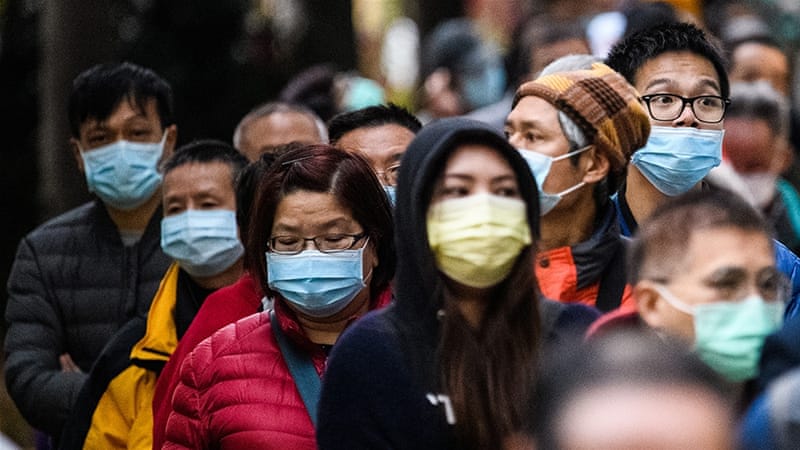
The ICJ today called on States in Southeast Asia to respect and protect human rights online and offline, in accordance with their obligations under international law, as they take steps to stop the spread of COVID-19.
It urged States to ensure that avoiding adverse impacts on the exercise of the rights to freedom of expression, opinion, information and privacy are front and center when implementing measures to counter misinformation about the virus.
“This is a health emergency, unprecedented in modern times, that calls for urgent, targeted and effective responses by the State including measures to curtail false or misleading information about the spread of COVID-19,” said Frederick Rawski, ICJ’s Director for Asia and the Pacific.
“However, such measures must be implemented in accordance with rule of law principles, and their enforcement should protect the rights to health and life just as much as the rights to free expression, opinion, information and privacy.”
Governments in Southeast Asia have introduced and begun to enforce severe measures to control information online about the virus. This raises concerns about the potential for State over-reach in light of how Southeast Asian governments have historically enforced laws to curtail rights and censor content online in violation of international law. This trend was mapped out in its 2019 regional report.
The ICJ’s concerns has already been substantiated by recent actions taken by law enforcement authorities in some countries in the region. Arrests and detentions for online expression, in some cases without a warrant, have been reported in the Philippines, Malaysia, Indonesia, Cambodia, Vietnam and Thailand. Some of the laws in these countries which the ICJ had identified in its report as non-compliant with international human rights standards have been mis-used to arrest, detain and charge individuals accused of spreading false information online on the COVID-19 virus.
Legal provisions pursuant to which these arrests have been made carry significant criminal penalties including imprisonment terms and heavy fines – in some cases for merely expressing criticism of government measures on social media, such as complaints about inadequate screening measures or a lack of government preparedness.
“We urge governments not to repeat the mistakes of the past. The mere perception that the law is being used to suppress speech will only undermine the credibility of State institutions at a time when maintaining public trust is crucial,” said Rawski.
“Misinformation can be curtailed using less intrusive means than arrests, detentions and disproportionately onerous fines or imprisonment terms.”
To download the full statement with background information, click here.
Contact
Frederick Rawski, ICJ Asia Pacific Regional Director, e: frederick.rawski(a)icj.org
See also
ICJ, ‘Southeast Asia: ICJ launches report on increasing restrictions on online speech’, 11 December 2019
Mar 31, 2020
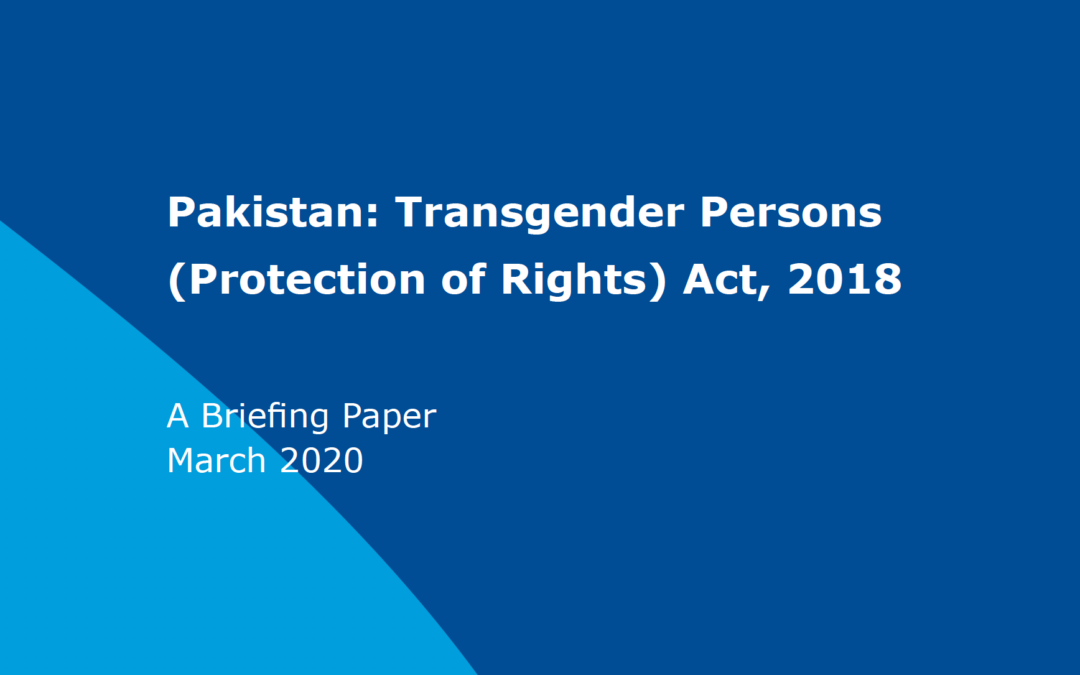
Today, on the International Transgender Day of Visibility (TDOV), the ICJ has released a briefing paper on Pakistan’s Transgender Persons (Protection of Rights) Act, 2018.
The briefing paper analyzes some of the more salient provisions of the Act in light of Pakistan’s obligations under international human rights law.
The paper specifically addresses: the definition of transgender people provided in the act; the procedures for legal gender recognition stipulated by the law; the provisions on anti-discrimination and harassment; the new criminal offence related to begging; and the adequacy and effectiveness of enforcement mechanisms, among other issues.
“The passage of the law is a testament to the hard work and struggle of the Pakistani transgender and queer communities, as well as the support and solidarity offered at different points by other social and civil society groups,” said Frederick Rawski, ICJ’s Asia Director.
“However, for the promise of the law to be realized in a manner that fully respects the human rights of transgender people, it is essential that this process does not end with the enactment of the legislation, and that authorities take an inclusive and proactive approach towards its enforcement.”
Under the law, transgender people have the right to have all their official documents changed and reissued in line with their self-identified gender, and the Act provides for legal recognition of gender identity as a matter of right without any medical or diagnostic requirements.
“This a crucial improvement in the legal status of transgender people in Pakistan, making the Act one of the most far-reaching in the region, if not world over,” added Rawski.
“Other countries that are grappling with similar legislation have much to learn from how the Pakistan’s Transgender Persons (Protection of Rights) Act, 2018 has responded to the question of legal gender recognition.”
However, there remain a number of limitations and omissions in the law, which could hamper the full protection of the human rights of transgender people in the country.
Some of them include: the conflation of transgender and intersex identities; the criminalization of “employing” or “using” transgender people for begging, despite evidence that such laws are used to harass and blackmail transgender people; the delay in formulating rules under the law to ensure its effective implementation; and the lack of adequate enforcement mechanisms.
In addition, it is of concern that other discriminatory legal provisions that violate the rights of transgender people, such as section 375 of the Pakistan Penal Code (PPC), which defines rape in an exclusionary and gendered manner, namely, by making it a crime that can only be committed by a man against a woman, and section 377 of the PPC, which criminalizes “carnal intercourse against the order of nature” are still in force.
The analysis in this paper provides some guidance to policy makers and members of parliament on how the law can be further strengthened.
The recommendations should be implemented, both at national and provincial levels, to make the Transgender Persons (Protection of Rights) Act the more consistent with Pakistan’s obligations under international law.
Contact:
Frederick Rawski (Bangkok), ICJ Asia Pacific Regional Director, e: frederick.rawski(a)icj.org
Reema Omer, ICJ Legal Advisor (South Asia) t: +447889565691; e: reema.omer(a)icj.org
Download
Briefing Paper Pakistan-Transgender-Advocacy-Analysis brief-2020-ENG (PDF)
Executive Summary Pakistan-Transgender-Summary-Advocacy-Analysis-brief-2020-ENG-URD (in English and Urdu, PDF)
Mar 30, 2020 | News
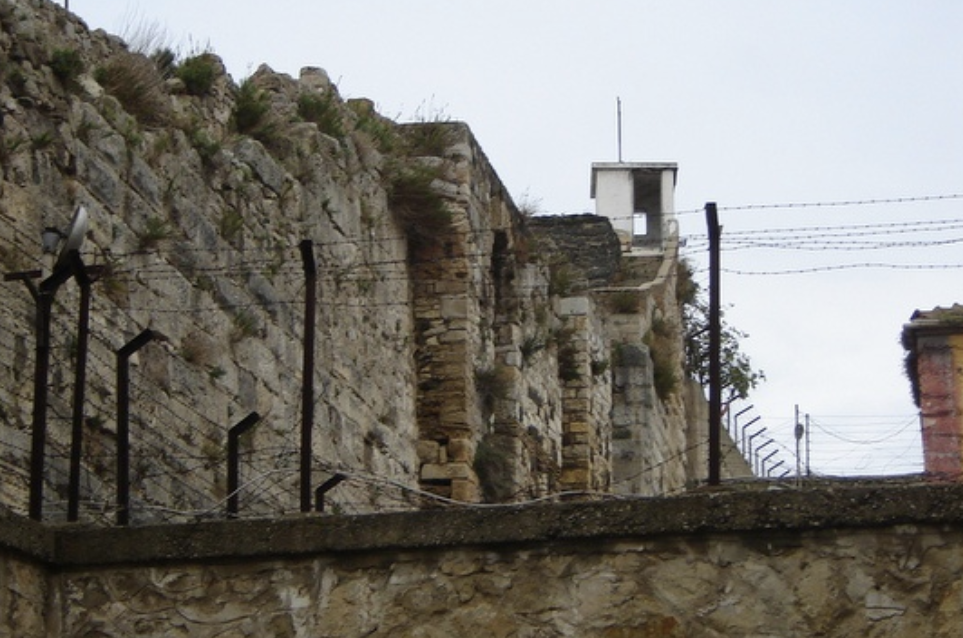
The ICJ is calling on the Turkish Parliament to extend the planned provision of alternatives to detention in response to the COVID-19 crisis to all those imprisoned for non-violent crimes who do not pose a current threat to members of the public, regardless of the nature of the offences for which they have been charged.
In particular, alternatives to detention should apply to all those detainees who are particularly at risk at losing their life or suffering severe health effects from COVID-19.
Measures to protect the right to life, the right to health and other human rights must apply equally and without discrimination in line with Turkey’s international legal obligations.
The government have announced the tabling of a draft law to reduce the prison population that has been under discussion in recent months. The process has been accelerated with the purported aim of addressing the serious health risk that an outbreak of COVID-19 contagion would pose to the prison population. However, the draft law has not been adapted to address the health crisis and contains several shortcomings.
The new measures would grant alternatives to detention, including house arrest or early parole to an estimated one-third of the prison population.
This welcome move is however limited by the exclusion of those convicted or under trial for terrorism offences or offences against the State.
“In Turkey, terrorism offences and offences against the State have long been abused to arrest, try and jail human rights defenders, lawyers, judges and political opponents,” said Massimo Frigo, Senior Legal Adviser for the ICJ Europe and Central Asia Programme. “The rights to life and health of these groups are now at particular risk.”
The ICJ considers that it is also essential that all detainees who are members of a group whose life or health may be at risk because of COVID-19 have either access to alternatives to detention, if they do not pose a current threat to public safety, or, otherwise, to detention conditions that may preserve them as far as possible from such risk.
“The State has a non-derogable obligation to protect the right to life of all its prison population, without discrimination of any sort,” Massimo Frigo added.
Mar 30, 2020 | Eventos, Noticias
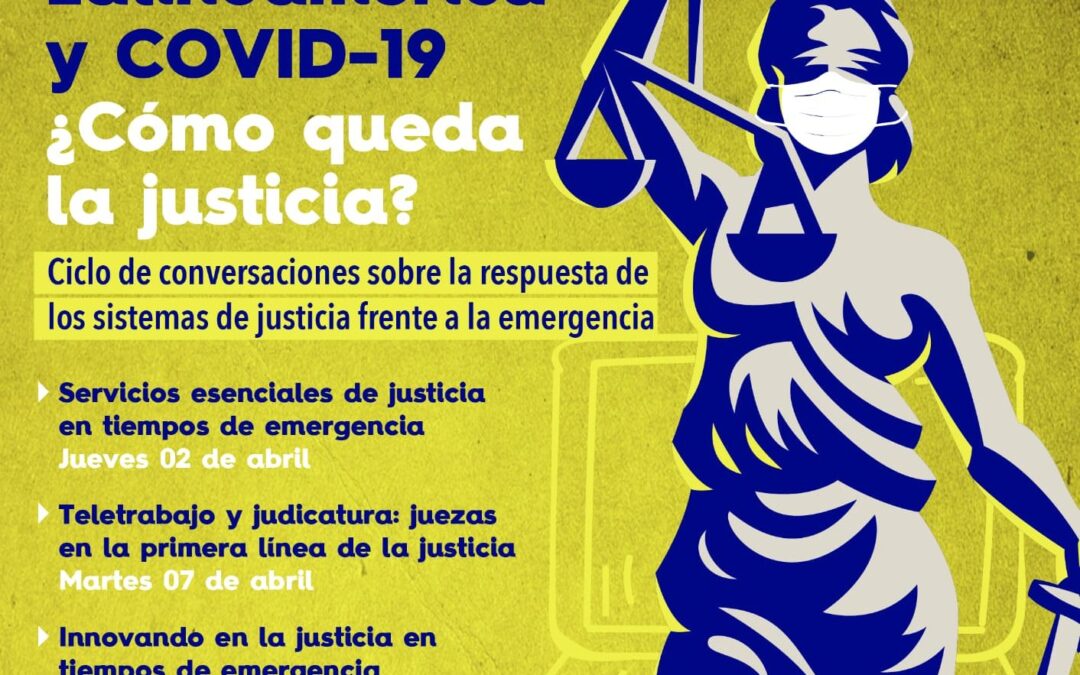
Los países de América Latina han adoptado diversas medidas excepcionales para enfrentar la pandemia, gestionar la crisis sanitaria y adoptar cuarentenas de la población. Estas medidas tienen efectos directos sobre los derechos básicos y las libertades de las personas.
Por este motivo, vale la pena preguntarse: ¿Cómo han reaccionado los sistemas de justicia frente a esta situación? ¿Qué se requiere para seguir garantizando el acceso a la justicia en esta coyuntura? ¿Cómo afecta la pandemia la prestación de los servicios de justicia? ¿Cómo puede innovar la justicia para dar una respuesta a las nuevas y crecientes demandas ciudadanas?
Por esto, la CIJ apoya una iniciativa que es liderada por un grupo de mujeres de América Latina que trabajan en temas de justicia en la región, que pretende analizar la respuesta de los sistemas de justicia frente a la emergencia generada por la pandemia. Esta iniciativa cuenta con el apoyo de DPLF, la Fundación Construir, la Fundación Tribuna Constitucional, el Observatorio de Derechos y Justicia, y la Fundación para la Justicia y el Estado Democrático del Derecho.
Los conversatorios se llevarán a cabo en español y a través de la plataforma Zoom; las inscripciones para cada conversatorio se pueden realizar enviando un correo electrónico a: info@dplf.org Las personas inscritas recibirán el link donde se podrá seguir la actividad.
Los primeros tres conversatorios son los siguientes:
- Servicios esenciales de la justicia en tiempos de emergencia: 2 de abril
14 horas México-Centroamérica/ 15 horas Colombia-Perú-Ecuador/ 16 horas Washington-Bolivia/ 17 horas Chile -Argentina
- Teletrabajo y judicatura: juezas en la primera línea de la justicia: 7 de abril
14 horas México-Centroamérica/ 15 horas Colombia-Perú-Ecuador/ 16 horas Washington-Bolivia/ 17 horas Chile -Argentina
- Innovando en la justicia en tiempos de emergencia: 9 de abril
14 horas México-Centroamérica/ 15 horas Colombia-Perú-Ecuador/ 16 horas Washington-Bolivia/ 17 horas Chile -Argentina
Mar 27, 2020 | News
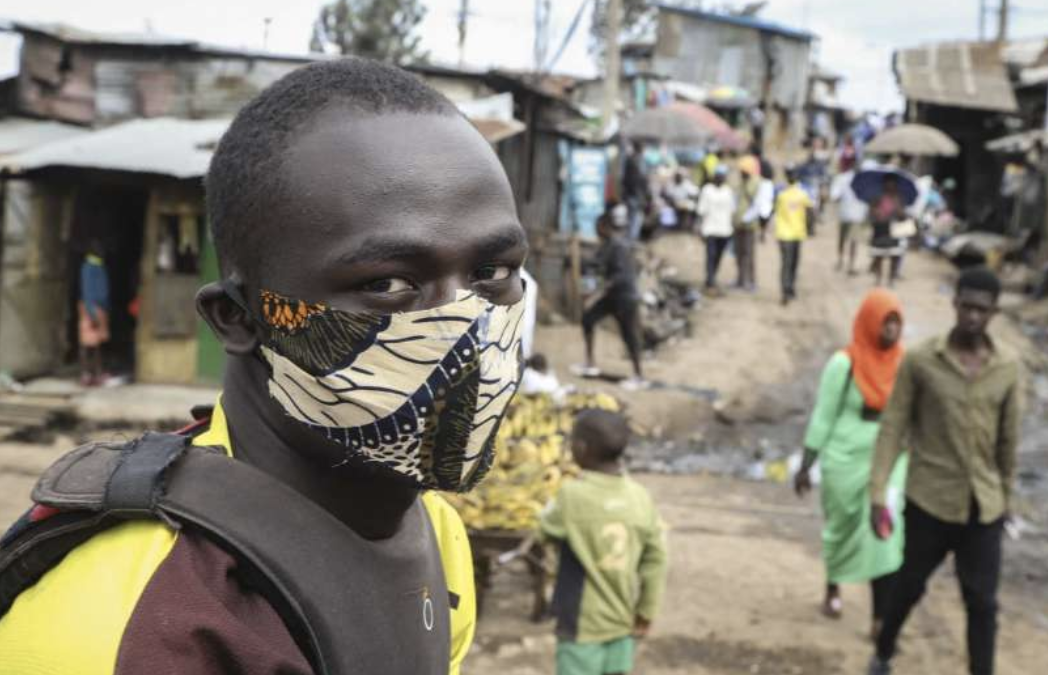
The ICJ today called on the responsible authorities to adopt urgent measures to ensure the equal protection of the right to health and life of the country’s inhabitants in the wake of the growing COVID-19 pandemic.
The call came amidst indications that official response has been inadequate and poorly conceived.
Although Zimbabwe has only three officially confirmed COVID-19 cases and one casualty so far, the true figures are likely to be higher.
Media reports indicate that the health care facilities designated to deal with COVID-19 cases are severely under equipped. Doctors and nurses have announced that they are withdrawing their services because government is failing to provide them with protective clothing such as masks and gloves.
“The ICJ is deeply concerned by the poor state of preparedness of the Zimbabwean Government to handle COVID-19 cases,” said Arnold Tsunga, ICJ African Programme Director.
“The COVID-19 pandemic has brought to the fore cracks in health systems and presented governments everywhere with unprecedented challenges. The government’s response should however remain steeped in obligations espoused in the Constitution and international legal instruments to which Zimbabwe is a party,” he added.
The ICJ called on the Government of Zimbabwe to take urgent measures, include those aimed at ensuring that its healthcare system can provide for adequate screening, testing and care for COVID-19 patients.
The ICJ said that the Government must also investigate reports of the mishandling of patients, increase transparency and regular communication with the public and dedicate more resources to dealing with the COVID-19 pandemic.
Background
Zimbabwe announced its first confirmed case of COVID-19 on 21 March. The first casualty was recorded on 23 March. On 25 March 2020, the Ministry of Health and Child Welfare reported that a total of 100 people had been tested for COVID-19. Of these, 96 were negative, three tested positive and one test was found to be inconclusive.
Zimbabwe is a party to the International Covenant on Economic, Social and Cultural Rights (ICESCR), which imposes a duty to protect the right of everyone to enjoyment of the highest attainable standard of physical and mental health. Zimbabwe is also party to the International Covenant on Civil and Political Rights and the African Charter on Human and Peoples Rights, both of which guarantee the right to life.
Pursuant to Section 76 (1) of the Constitution of Zimbabwe, the government must provide access to basic health care services to all citizens and residents. Further, section 76 (3) of the Constitution enjoins government to ensure that no person is denied emergency medical treatment in any health care facility. In addition, government has an obligation, under section 51 of the Constitution, to protect human dignity.
The Committee on Economic, Social and Cultural Rights has set out the minimum standards which must be fulfilled at all times for States that are party to the IECSCR;
- Quality: Heath care facilities should be equipped with necessary equipment and medicine including safe and adequate water, sanitation and skilled medical professionals.
- Availability: Health care facilities with adequately trained and fairly-paid medical personnel and essential medicines should be made available to all.
- Accessibility: Health care facilities should be accessible to all without discriminating. Accessibility also includes physical accessibility, economic accessibility and access to information.
- Acceptability: Health care services should be provided in a manner that complies with medical ethics.
Measures undertaken by the Government of Zimbabwe, in response to the COVID-19 pandemic must adhere to these minimum standards. However, the ICJ has noted the following allegations and reports from credible media sources;
- Gross under-testing of people despite showing most of the COVID-19 symptoms;
- Absence of protective gear for health care workers;
- Lack of training of health care workers on the proper handling of COVID-19 related patients;
- Mishandling/ill treatment of patients at COVID-19 health care centres;
- Absence of equipment such as ventilators and respirators;
- Absence of running water at designated COVID-19 health care centres;
- Insufficient staffing at the designated COVID-19 care and isolation centres, as a result of some doctors and nurses having gone on strike;
- Government is establishing fully equipped COVID-19 health care facilities but exclusively for the political elites and their associates.
Contact:
Arnold Tsunga, Director of the ICJ Africa Regional Programme, t: +263 77 728 3248, e: arnold.tsunga(a)icj.org