Nov 7, 2013 | News
FIDH, ILGA-Europe, ICJ, AIRE-Centre and HLHR welcome this important decision. The organizations had submitted written comments about the case to the Court in June 2011.
In a judgment in the joint cases of Vallianatos and Mylonas v. Greece and C.S. and others v. Greece delivered today, the Grand Chamber of the European Court of Human Rights ruled that Greece had violated the European Convention on Human Rights by excluding same-sex couples from a “civil union”, restricted in Greece to heterosexual couples.
“All Member States of the Council of Europe must condemn any form of discrimination against homosexuals. Homosexual couples, as heterosexual couples, involved in a stable relationship, should benefit from a legal recognition”, said Karim Lahidji, FIDH President. He added: “Twenty-two of the Member States of the Council of Europe have created a legal form of recognition for same-sex couples. Greece must change its law to comply with the European Convention on Human Rights”.
Evelyne Paradis, Executive Director of ILGA-Europe, said: “The European Court of Human Rights reaffirmed already established principle that sexual orientation discrimination is in breach of the European Convention. Now the Court took yet another step to say that if a country provides legal recognition to unmarried heterosexual couples in a form of civil unions, same-sex couples also must be able to benefit from such legal recognition. European consensus on the legal recognition of same-sex partnership is constantly growing and we welcome the fact the Court is taking it into account and reflect in its jurisprudence.”
Livio Zilli, Senior Legal Adviser at the International Commission of Jurists, said: “The Court reiterated that the Convention was a living instrument to be interpreted in the present-day conditions and that the state was obliged under the Convention to take account of societal developments, as well as the fact that there is no single way or choice when it came to people’s exercise and enjoyment of their right to family or private life.”
In its decision, the Court ruled that Greece had failed to provide a convincing justification for excluding same-sex couples.
The Government’s argument, according to which the law’s main purpose was to protect children of unmarried parents, did not constitute a valid reason, because the law’s real objective was the legal recognition of a new form of family life.
Therefore, exclusion of same-sex couples breaches the Convention.
In November 2008, Greece adopted a law creating the “civil unions”, an alternative to marriage.
However, the first article restricts such unions to “two physical individuals of different sex who have reached the age of majority”. An animated debate relating to the inclusion of same-sex couples took place before the adoption of this law.
During the debate before the Hellenic Parliament, the Minister of Justice at the time, declared: “We mustn’t include same sex couples. We are indeed convinced that the needs and demands of the Hellenic society do not cross this line; as a legislator, the political party in power is accountable to the Greek people; we have our own beliefs and negotiations are over; I believe it is the way to go”.
In their written comments, FIDH, ILGA-Europe, ICJ and AIRE-Centre recalled that the European Court has repeatedly condemned direct discrimination based on sexual orientation as a violation of protected rights.
The Court’s case-law reiterates that when it comes to a difference in treatment based on sex or sexual orientation, the principle of proportionality does not merely require that the measure chosen is in principle suited for realising the aim sought.
It must also be shown that the discriminatory treatment is necessary in order to achieve that aim, otherwise the measure will be in violation of the Convention. Creating a “civil union” only for unmarried different-sex couples amounts to direct discrimination and therefore violates the Convention.
Today’s decision follows recent jurisprudence of the Court against discrimination of same-sex couples. On February 2013, in the X. and others v. Austria case, the European Court condemned Austria for banning a homosexual person to adopt the biological child of his/her partner. It decided that the ban of unmarried same-sex couples, which are in the same situation than unmarried different-sex couples, was not justified and violated article 14 of the Convention in conjunction with article 8.
Contact:
Livio Zilli, Senior Legal Adviser, ICJ, e-mail: livio.zilli(a)icj.org
Additional information:
- Judgement of the European Court of Human Rights in the case of Vallianatos and Mylonas v. Greece and C.S. and others v. Greece
- According to the Rainbow Europe’s Index (May 2013), Greece came 25th among 49 European countries in terms of laws and policies affecting the human rights of LGBTI people.
Greece-Vallianatos_CEDH-news-press release-2013-FR (full French text in pdf)

Nov 7, 2013 | Публикации
Множество женщин в Казахстане сталкиваются с рядом серьезных правовых и процессуальных проблем и препятствий в попытках добиться справедливости после случаев дискриминации и гендернообусловленного насилия, говорится в новом докладе МКЮ.
Опубликованный сегодня доклад «Доступ женщин к правосудию в Казахстане: определение препятствий и потребности в переменах» оценивает некоторые из существующих проблем и недостаточной правовой защиты [и доступа к средствам правовой защиты при нарушениях] в ситуациях дискриминации, а также сексуального и бытового насилия .
Он подчеркивает, что существенные недостатки и пробелы материального и процессуального права в Казахстане, касающихся дискриминации и насилия в отношении женщин, подрывают возможность женщин добиться правовой защиты .
«Содействие гендерному равенству и предотвращение насилия и дискриминации в отношении женщин требуют постоянного участия и долгосрочных обязательств. В этом процессе необходимы длительные усилия. Казахстан должен принять серьезные меры по решению вопросов, указанных в настоящем докладе, с тем, чтобы обеспечить соответствие его законов и процедур потребностям женщин и защите их прав на практике», – заявила Лея Хоктор, юрист Программы МКЮ по правам женщин.
В докладе подробно описывается, каким образом международное право прав человека обязывает Казахстан принять эффективные и значимые шаги для обеспечения того, чтобы его законодательство адекватно регулировало вопросы дискриминации и насилия в отношении женщин.
«Настоящий доклад предоставляет государственным структурам, представителям гражданского общества и адвокатам важные ориентиры в отношении содержания международных обязательств Казахстана по продвижению доступа женщин к правосудию», – сказал Тимур Шакиров, юрист Европейской программы МКЮ.
Контакты:
Лиа Хоктор: leah.hoctor(a)icj.org
Тимур Шакиров: temur.shakirov(a)icj.org
Kazakhstan-Women’s Access to Justice-press release-2013-RUS (полный текст)
Kazakhstan-Women’s Access to Justice-Publications-Report-2013-RUS (доклад)

Nov 7, 2013 | Events, News
The ICJ addressed the 15th Meeting of the European Network of Contact Points for investigation and prosecution of genocide, crimes against humanity and war crimes.
The meeting, which took place in the Hague, had a focus on criminal responsibility of corporations and business persons for serious international crimes and congregated a number of European public prosecutors and investigators.
In its presentation, Carlos Lopez, Senior Legal Adviser at ICJ, addressed ways to overcome difficulties in prosecuting business corporations.
He focused on three cases that are among the ones most advanced in the investigation and prosecution stage of business corporations for crimes under international law: the Riwal/Lima Holding, the Amesys and the Lundin Petroleum cases.
They illustrate the acute dilemmas that public prosecutors are likely to face in these kind of cases and how difficult to solve them it may be.
The full ICJ presentation and the agenda of the meeting can be downloaded in pdf format below.
The Hague Meeting-Prosecuting corporations-Presentation-analysis brief-2013
The Hague Meeting-Prosecuting corporations-Agenda-2013
Nov 6, 2013 | News
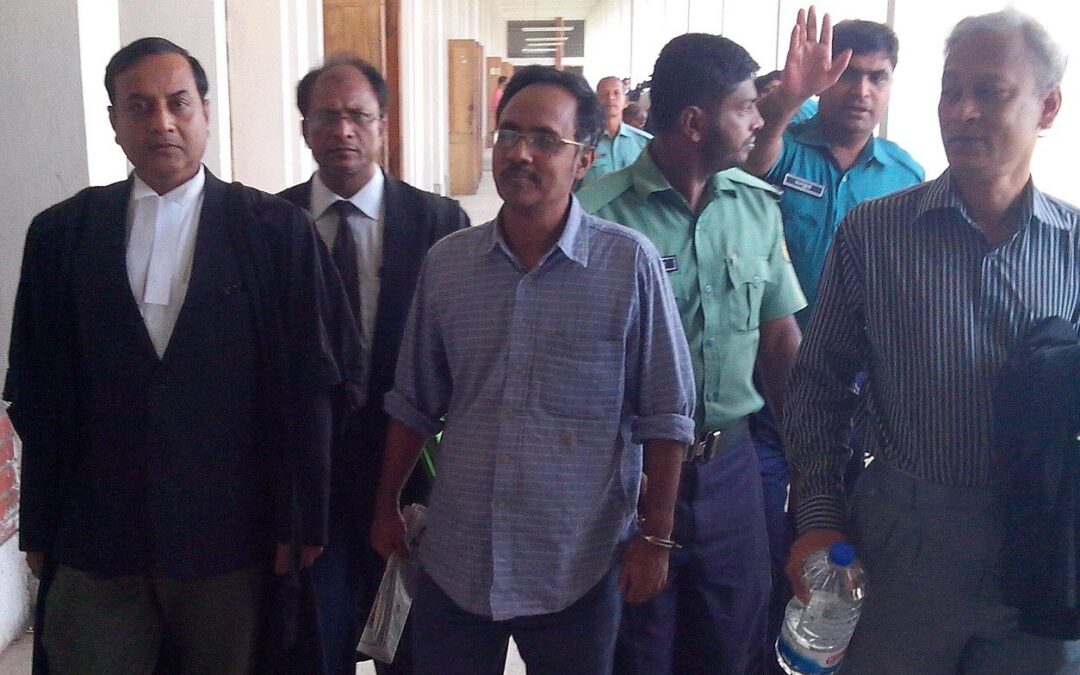
The ICJ is calling on the Bangladeshi authorities to immediately and unconditionally release Nasiruddin Elan, Director of the human rights group Odhikar.
Odhikar is an affiliate organization of the ICJ.
On 6 November 2013, a Dhaka cyber crimes tribunal rejected Nasiruddin Elan’s bail application and ordered his detention in Dhaka Central Jail.
Nasiruddin Elan (in the middle on the picture) has been accused of distorting information, presenting false evidence and manipulating photographs of a Government crackdown on a rally by Hefazat-e-Islam, an Islamist political organization, in May this year.
The action reportedly resulted in multiple deaths and injuries. Odhikar had reported that 61 protestors were killed by the Rapid Action Battalion (RAB) and the police. The Government contests the number of casualties.
“What we are seeing is a continuing unlawful attack on Odhikar and voices critical of the Government,” said Ben Schonveld, ICJ’s South Asia Director. “Nasiruddin Elan is being arbitrarily detained for the lawful exercise of the right to freedom of expression and his legitimate work as a human rights defender.”
“The Government should immediately drop its opposition to Nasiruddin Elan’s bail application,” he added. “We are concerned that he will be one of the many detainees who faces torture and ill-treatment during detention, as documented by Odhikar and other human rights organizations.”
Bangladesh-Elan arrest statement-news-web story-2013 (full text in pdf)

Nov 5, 2013 | Новости, Статьи
Международная комиссия юристов (МКЮ) сегодня приветствовала освобождение 1-го ноября адвоката Зинаиды Мухторовой из психиатрической лечебницы в Астане, Казахстан.
Адвокат принудительно содержалась в психиатрическом учреждении «Медицинский центр проблем психиатрического здоровья» в течение неполных трех месяцев.
Не смотря на освобождение, сообщается, что в данный момент отсутствуют результаты психиатрической экспертизы.
«В то время как освобождение адвоката можно только приветствовать, МКЮ по-прежнему обеспокоена тем, что задержание Зинаиды Мухторовой представляло собой ответную меру на законное осуществления ею своих профессиональных обязанностей адвоката в нарушение ее права на свободу, а также Основных принципов ООН, касающихся роли юристов», – сказала Роушин Пиллей , директор программы МКЮ по Европе.
«В данный момент необходимо обеспечить, чтобы Зинаида Мухторова могла оспорить законность ее лишения свободы на основе справедливой процедуры, и получить соответствующие возмещение за любое нарушение ее прав человека», – добавила она.
Зинаида Мухторова была помещена в психиатрическую лечебницу 9 августа после того как ее силой увезли из своего дома несколько сотрудников полиции и медицинского персонала.
Среди причин для ее содержания в психиатрической лечебнице были ее «возможное возникновение кверулянтской» деятельности и «сутяжничество».
МКЮ ранее выражала обеспокоенность тем, что ее содержание психиатрическом учреждении строилось на основаниях, состоящих в осуществлении законной профессиональной деятельности в качестве адвоката.
МКЮ продолжает следить за этим делом, в том числе за текущими обжалованиями в судах Казахстана законности содержания Зинаиды Мухторовой в психиатрических учреждениях в данном и предыдущем случаях.
В этой связи МКЮ призывает правительство обеспечить справедливость судебных процедур, обжалующих ее содержание под стражей.
Контакты:
Роушин Пиллей, директор Региональной программы МКЮ по Европе, roisin.pillay(a)icj.org
Тимур Шакиров, правовой советник Региональной программы МКЮ по Европе, temur.shakirov(a)icj.org
Kazakhstan-Mukhtorova statement-news-webstory-2013-Rus (полный текст, PDF)