Oct 19, 2018 | Advocacy, Non-legal submissions
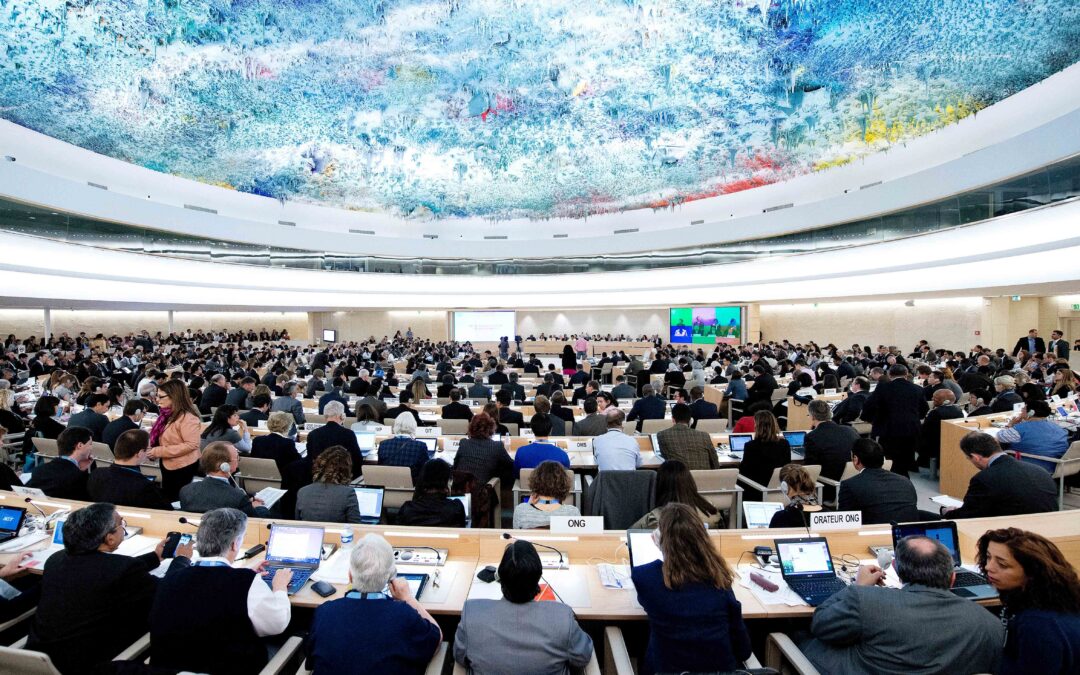
The International Commission of Jurists participated in the fourth session of the open-ended intergovernmental working group on transnational corporations and other business enterprises with respect to human rights that took place at the Palais de Nations from 15-18 October 2018. Below are the interventions the ICJ made at this session.
UN-ICJ statement IGWG4 general debate-Advocacy-ENG-2018
UN-ICJ statement IGWG4 prevention-Advocacy-ENG-2018
UN-ICJ statement IGWG4 legal liability-Advocacy-ENG-2018
Sep 18, 2018 | Événements, Multimédia, Nouvelles
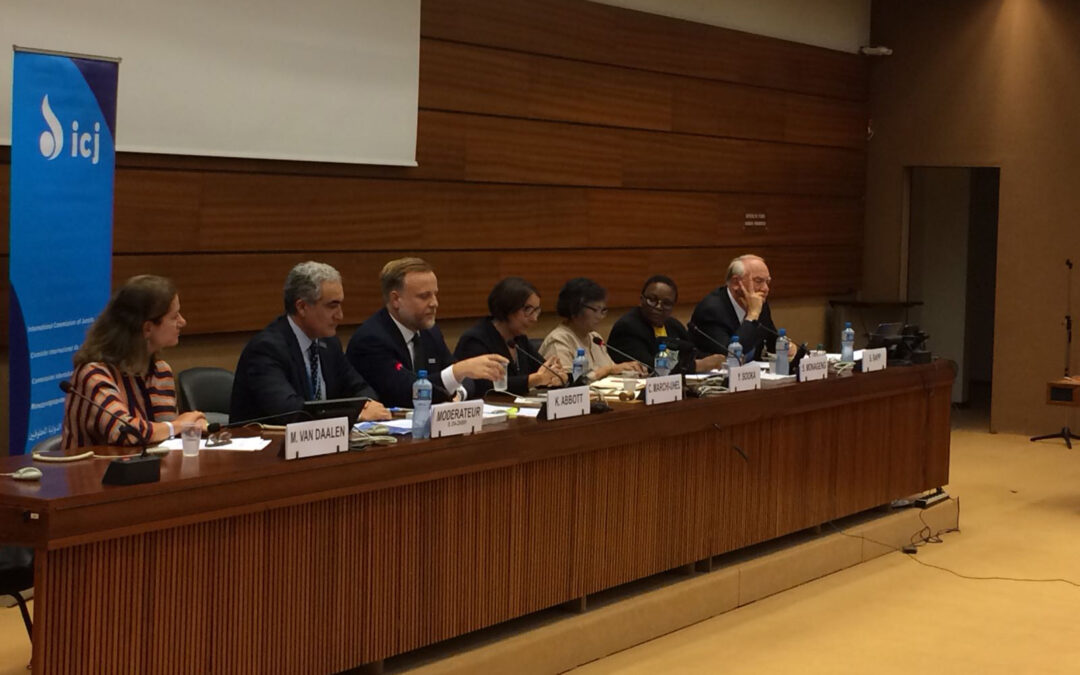
La CIJ a organisé cet événement parallèle aujourd’hui (mardi 18 septembre 2018) au Conseil des droits de l’Homme, en coopération avec la Mission permanente des Pays-Bas.
https://www.facebook.com/ridhglobal/videos/1005764152964172/
Contexte
En particulier lorsque des crimes de droit international sont perpétrés à grande échelle dans des situations de crise, il est urgent de préserver les preuves pouvant être utilisées lors de procédures pénales éventuelles, que ce soit devant la Cour pénale internationale ou d’autres tribunaux nationaux ou internationaux.
Trop fréquemment, des obstacles empêchent un recours direct aux tribunaux et procureurs internationaux. L’une des réponses a été la création de mécanismes pour collecter et conserver les preuves pendant ce temps. Les exemples incluent le Mécanisme international indépendant et impartial (IIIM) pour la Syrie et la Commission des droits de l’Homme au Sud Soudan.
À la présente session du Conseil des droits de l’Homme, la mission d’enquête sur le Myanmar a appelé à la création d’un IIIM dans l’attente d’une saisine de la CPI ou d’un tribunal ad hoc.
Discours d’ouverture
Ambassadeur Monique T.G. van Daalen, Mission permanente des Pays-Bas
Modérateur:
Saman Zia-Zarifi, Secrétaire général de la Commission internationale des juristes
Panélistes:
- Catherine Marchi-Uhel, cheffe du Mécanisme international indépendant et impartial (IIIM) pour la Syrie
- Yasmin Sooka, présidente de la Commission des droits de l’homme au Sud Soudan
- Sanji Monageng, ancienne juge / vice-présidente de la CPI et commissaire de la CIJ
- Stephen Rapp, président de la Commission pour la justice internationale et la responsabilité (CIJA), membre émérite du US Holocaust Memorial Museum, et ancien ambassadeur des États-Unis chargé pour la justice pénale mondiale
- Kingsley Abbott, conseiller juridique principal de la CIJ, anciennement aux Chambres Extraordinaires au sein des Tribunaux Cambodgiens et du Tribunal spécial pour le Liban
Universal-ICJ-NL-Side event-News-events-2018-ENG (prospectus de l’événement en PDF uniquement en anglais)
Sep 18, 2018 | Events, Multimedia items, News, Video clips
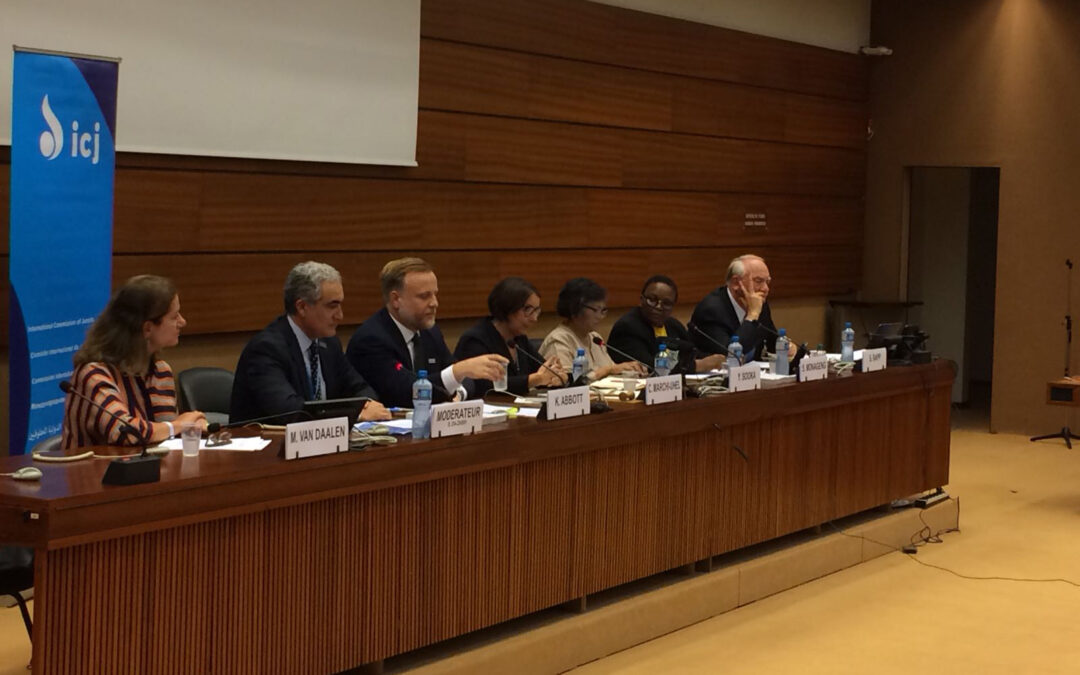
The ICJ organized this side event today (Tuesday 18 September 2018), in cooperation with the Permanent Mission of the Netherlands, at the Human Rights Council.
https://www.facebook.com/ridhglobal/videos/1005764152964172/
Background
Particularly when crimes under international law are perpetrated on a large scale in situations of crisis, there is an urgent need to preserve evidence for use in eventual criminal proceedings, whether at the International Criminal Court or other national or international tribunals
Too frequently, obstacles prevent immediate direct recourse to international courts and prosecutors. One response has been the creation of mechanisms to collect and preserve the evidence in the meantime. Examples include the International Independent and Impartial Mechanism (IIIM) for Syria, and the Commission on Human Rights in South Sudan.
At the current session of the Human Rights Council, the Fact-Finding Mission on Myanmar has called for establishment of an IIIM pending referral to the ICC or an ad hoc tribunal.
Opening Remarks:
Ambassador Monique T.G. van Daalen, Permanent Mission of the Netherlands
Moderator:
Saman Zia-Zarifi, Secretary General, International Commission of Jurists
Panelists:
- Catherine Marchi-Uhel, Head, International, Impartial and Independent Mechanism (IIIM) for Syria
- Yasmin Sooka, Chairperson, Commission on Human Rights in South Sudan
- Sanji Monageng, former Judge/Vice-President of the ICC, and Commissioner of the ICJ
- Stephen Rapp, Chair, Commission for International Justice & Accountability (CIJA), Distinguished Fellow, US Holocaust Memorial Museum, and former United States Ambassador-at-Large for Global Criminal Justice
- Kingsley Abbott, ICJ Senior Legal Adviser (Global Accountability), formerly with the Extraordinary Chambers in the Courts of Cambodia and the Special Tribunal for Lebanon
Universal-ICJ-NL-Side event-News-events-2018-ENG (flyer of the event in PDF)
Sep 18, 2018
The ICJ today urged States not to vote for candidates whose human rights records should disqualify them from membership, in upcoming elections to the UN Human Rights Council.
The ICJ together with dozens of other NGOs made the call in an open letter to all UN member States:
“To Permanent Representatives of Member States of the UN General Assembly
18 September 2018
Member States of the UN should refrain from voting for candidates to the Human Rights Council that are unfit for membership
Excellencies,
Ahead of the next UN Human Rights Council (“HRC” or “the Council”) election, we, the undersigned national, regional and international civil society organisations, write to urge your delegation to refrain from voting for candidates that blatantly fail to fulfil the Council membership standards outlined in UN General Assembly (UNGA) resolution 60/251.
Paragraphs 8 and 9 of resolution 60/251 state that the UNGA:
- Decides that the membership in the Council shall be open to all States Members of the United Nations; when electing members of the Council, Member States shall take into account the contribution of candidates to the promotion and protection of human rights and their voluntary pledges and commitments made thereto […];
- Decides also that members elected to the Council shall uphold the highest standards in the promotion and protection of human rights [and] fully cooperate with the Council […].
We are concerned that several of the States that are running for election fail to fulfil minimal requirements with regard to both the promotion and protection of human rights and cooperation with the Council and other UN human rights bodies and mechanisms. Some of these candidates show a pattern of non-cooperation with the UN human rights system and attacks against UN Special Procedure Mandate-Holders that is incompatible with Council membership. Furthermore, some of this year’s candidates have engaged in acts of intimidation and reprisals against human rights defenders and civil society organizations, who play a key role in the Council’s work. Voting for these candidates would undermine the Council’s credibility and institutional integrity.
We urge you to treat human rights considerations and the substantive Council membership criteria outlined in resolution 60/251 as paramount in electing members to the Council, rather than engaging in vote trading or privileging political considerations over fundamental human rights.
In October 2018, the next HRC election will determine which States sit as Members of the Council in the next three years (2019-2021). Considering that States must receive a simple majority of votes (i.e., 97) to be elected, that voting takes place by secret ballot, and that electing States are under no obligation to vote for each and every candidate within a regional group, we urge your delegation to simply refrain from voting for unfit candidates. Doing so will require leaving the ballot blank for those candidate States your delegation considers unfit.
Sincerely,
African Centre for Democracy and Human Rights Studies (ACDHRS)
African Centre for Justice and Peace Studies (ACJPS)
Americans for Democracy & Human Rights in Bahrain (ADHRB)
ARTICLE 19
Asian Forum for Human Rights and Development (FORUM-ASIA)
Asian Legal Resource Centre (ALRC)
Bahrain Institute for Rights and Democracy (BIRD)
Cairo Institute for Human Rights Studies
Centro de Estudios Legales y Sociales (CELS)
CIVICUS: World Alliance for Citizen Participation
Commonwealth Human Rights Initiative (CHRI)
Conectas Direitos Humanos
Connection e.V., Germany
DefendDefenders (the East and Horn of Africa Human Rights Defenders Project)
EEPA
Eritrea Focus
Eritrean Diaspora in East Africa (EDEA)
Eritrean Law Society (ELS)
Eritrean Movement for Democracy and Human Rights (EMDHR)
Geneva for Human Rights (GHR)
Global Centre for the Responsibility to Protect
Global Initiative for Economic, Social and Cultural Rights
Horn of Africa Civil Society Forum
Human Rights Association / İnsan Hakları Derneği (İHD)
Human Rights Concern – Eritrea (HRCE)
Human Rights House Foundation
Human Rights Law Centre
Human Rights Watch
Information Forum for Eritrea (IFE)
International Commission of Jurists
International Federation of Action by Christians for the Abolition of Torture (FIACAT)
International Federation for Human Rights (FIDH)
International Humanist and Ethical Union (IHEU)
International Movement Against All Forms of Discrimination and Racism (IMADR)
International Service for Human Rights
Network of Eritrean Women
PEN Eritrea
Reporters Without Borders (RSF)
Southern Africa Human Rights Defenders Network (SAHRDN)
World Organisation Against Torture (OMCT)
Zimbabwe Lawyers for Human Rights (ZLHR)”
Sep 17, 2018 | Events, Multimedia items, News, Video clips
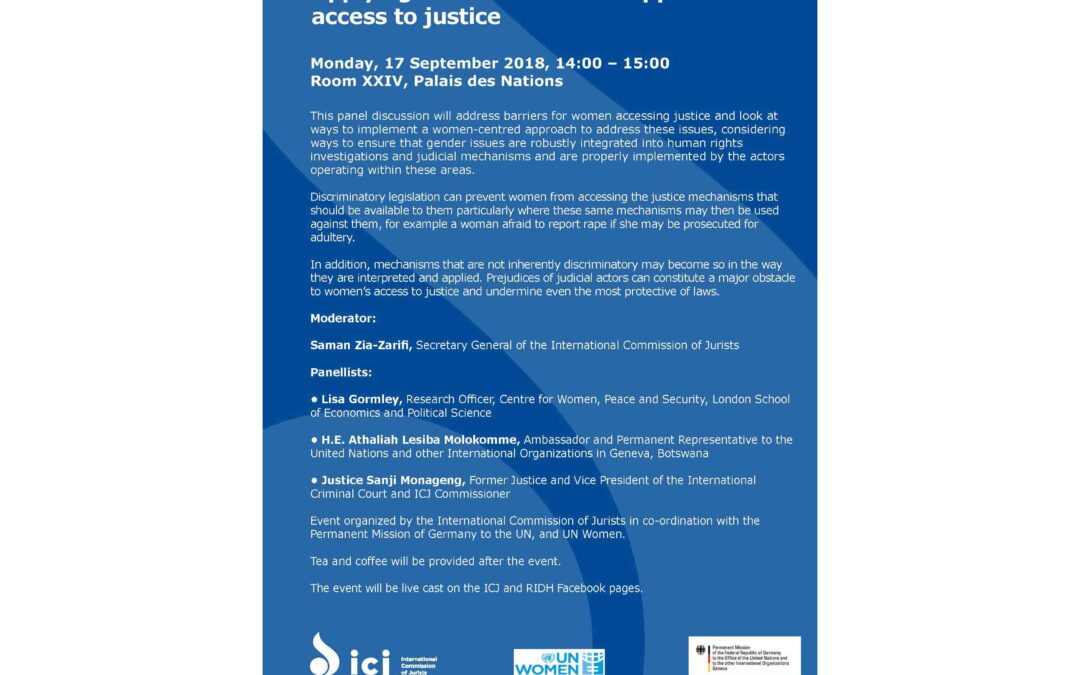
This panel discussion was held today at the Palais des Nations in Geneva.
The event addressed barriers for women accessing justice and look at ways to implement a women-centred approach to address these issues, considering ways to ensure that gender issues are robustly integrated into human rights investigations and judicial mechanisms and are properly implemented by the actors operating within these areas.
Discriminatory legislation can prevent women from accessing the justice mechanisms that should be available to them particularly where these same mechanisms may then be used against them, for example a woman afraid to report rape if she may be prosecuted for adultery.
In addition, mechanisms that are not inherently discriminatory may become so in the way they are interpreted and applied. Prejudices of judicial actors can constitute a major obstacle to women’s access to justice and undermine even the most protective of laws.
Moderator:
Saman Zia-Zarifi, Secretary General of the International Commission of Jurists
Panellists:
• Lisa Gormley, Research Officer, Centre for Women, Peace and Security, London School of Economics and Political Science
• H.E. Athaliah Lesiba Molokomme, Ambassador and Permanent Representative to the United Nations and other International Organizations in Geneva, Botswana
• Justice Sanji Monageng, Former Justice and Vice President of the International Criminal Court and ICJ Commissioner
Event organized by the ICJ in co-ordination with the Permanent Mission of Germany to the UN, and UN Women.
Watch the video:
https://www.facebook.com/ridhglobal/videos/565112000574216/
Side event ICJ WHR (flyer in PDF)