Sep 14, 2018
La CIJ a publié son rapport annuel 2017 (disponible uniquement en anglais), qui offre un résumé concis du travail effectué par la CIJ au cours de l’année écoulée.
Pendant plus de 60 ans, la CIJ a joué un rôle prépondérant dans la promotion de l’état de droit et de sa mise en œuvre au niveau international et national, et a travaillé sans relâche pour lutter contre les injustices à travers le monde.
Bien que des progrès notables aient été réalisés au fil des ans, nous sommes malheureusement dans une période de régression, confrontés à de nouveaux défis qui ne proviennent pas d’un clivage Est/Ouest ou Nord/Sud, mais plutôt problème d’ordre mondial et endémique.
La CIJ l’a cependant déjà constaté auparavant. Après les attentats terroristes du 11 septembre, de nombreux états, y compris des démocraties libérales, ont adopté des mesures antiterroristes qui menaçaient l’essentiel du cadre international des droits de l’Homme mis en place depuis la seconde guerre mondiale, affirmant que le respect des droits de l’Homme n’était plus adéquat.
La CIJ a réagi à cette crise en créant un panel de juristes éminents, dont le rapport identifiait clairement les enjeux, réaffirmant la valeur des droits de l’Homme et formulant des recommandations claires aux Etats sur la manière de concevoir des projets antiterroristes respectueux des droits fondamentaux.
Aujourd’hui, le concept de l’état de droit lui-même est attaqué et la CIJ, comme par le passé, relève ce défi en réaffirmant les valeurs et principes fondamentaux du droit relatif aux droits de l’Homme, et en cherchant à surmonter les propos dommageables qui prétendent que le système n’est plus pertinent pour les individus.
Bien que la CIJ reconnaisse que le système de droits est confronté à des défis, nous restons fermement attachés à renforcer la protection des droits grâce à des cadres internationaux éprouvés.
En 2017, la CIJ a abordé des éléments clés de l’état de droit, notamment l’indépendance du pouvoir judiciaire, qui constitue une garantie fondamentale pour la protection des droits et de la responsabilité.
Nous avons continué d’œuvrer à notre vision d’un monde où chacun puisse exercer ses droits en travaillant avec et au nom des groupes les plus marginalisés, notamment les habitants déplacés de l’État de Rakhine, les enfants migrants et les communautés autochtones.
Nous avons continué à lutter contre la culture de l’impunité et pour garantir la responsabilité dans des endroits tels que le Cambodge, le Myanmar, le Népal, le Tadjikistan et la Tunisie.
Il est important de noter que la CIJ a déjà connu quelques succès dans ce travail, notamment dans ses efforts pour plaider contre la proposition faite par l’Afrique du Sud de se retirer de la Cour pénale internationale.
L’année dernière, la CIJ a aussi organisé un forum sur les systèmes de justice coutumiers et traditionnels et dénoncé l’incapacité des états à rendre des comptes sur les opérations de restitution.
Elle a été activement impliquée dans des questions telles que l’accès à la justice pour les femmes, préconisé des réformes nationales, travaillé avec des systèmes judiciaires nationaux, dispensé des formations aux juristes et aux défenseurs des droits de l’Homme, et continué à dénoncer les violations flagrantes des normes internationales, telles que le recours à des tribunaux militaires pour juger des civils.
Les remises en question actuelles en matière de droits de l’Homme et notamment du cadre juridique international qui les soutient sont en effet très graves.
La CIJ, par son expérience et ses actes, est particulièrement qualifiée pour relever le défi mais cela exigera que nous réaffirmions vigoureusement notre vision d’un état de droit respectueux de la dignité et des droits de l’Homme de chacun.
Télécharger
Universal-ICJ Annual Report 2017-Publications-Reports-Annual Report-2018-ENG (rapport complet en PDF, uniquement disponible en anglais)
Sep 14, 2018
The ICJ has issued its Annual Report 2017, which offers a concise summary of the work carried out by the ICJ over the past year.
For over 60 years, the ICJ has played a preeminent role in promoting the rule of law and its implementation internationally and domestically and has worked tirelessly to fight injustices around the globe.
While notable progress has been made over the years, sadly we are now in a period of regression, facing new challenges that are neither East/West nor North/South in origin but are rather global and endemic.
The ICJ, however, has seen this before. After the 9/11 terrorist attacks, many States, including some liberal democracies, adopted counter-terrorism measures that threatened the very core of the international human rights framework put in place since the Second World War, claiming that observance of human rights was no longer convenient.
The ICJ responded to that crisis by establishing an Eminent Jurists Panel whose report clearly identified the issues, reaffirmed the value of human rights and set out clear recommendations to States on how to craft counter-terrorism initiatives that respect basic rights.
Today the concept of the rule of law itself is under attack, and the ICJ, as in the past, is meeting this challenge head on by reasserting core values and principles of human rights law and by seeking to overcome harmful narratives that claim that the system is no longer relevant to individuals.
While the ICJ recognizes the rights system is beset by challenges, we remain deeply committed to enhancing rights protections through tried and tested international frameworks.
The ICJ has had an active 2017 addressing key elements of the rule of law, including the independence of the judiciary, which provides a fundamental safeguard for rights protections and accountability.
We have continued to work towards our vision of a world where everyone is able to exercise her/his rights by working with and on behalf of the most marginalized groups, including displaced inhabitants of the Rakhine state, migrant children and indigenous communities.
We continued to strive against cultures of impunity and ensuring accountability in places such as Cambodia, Myanmar, Nepal, Tajikistan and Tunisia.
Importantly, the ICJ has already had some successes in this work, such as in the ICJ led efforts to advocate against South Africa’s proposed withdrawal from the International Criminal Court.
Last year, the ICJ also convened a forum on customary and traditional justice systems, reported on the failure of States to ensure accountability for renditions operations, actively engaged at the UN on issues such as women’s access to justice, advocated for national reforms, worked with domestic justice systems, provided training for jurists and rights defenders, and continued to denounce clear violations of international norms, such as the use of military courts to try civilians.
The current challenges to human rights and the international legal framework supporting them are grave indeed.
The ICJ by experience and deeds is uniquely qualified to meet these challenges but this will require us to vigorously reaffirm our vision of a rule of law that upholds the dignity and human rights of every person.
Download
Universal-ICJ Annual Report 2017-Publications-Reports-Annual Report-2018-ENG (full report in PDF)
Sep 11, 2018 | Events, News
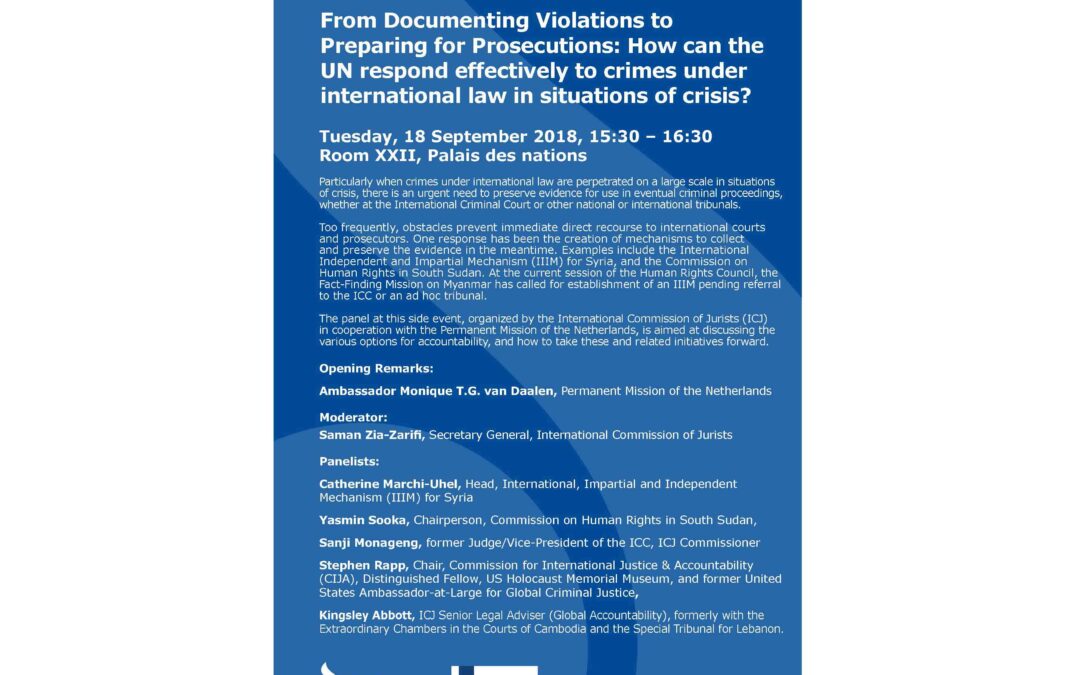
The ICJ will organize this side event, in cooperation with the Permanent Mission of the Netherlands, at the Human Rights Council on Tuesday 18 September 2018 from 15:30 – 16.30 in Room XXII of the Palais des Nations.
Particularly when crimes under international law are perpetrated on a large scale in situations of crisis, there is an urgent need to preserve evidence for use in eventual criminal proceedings, whether at the International Criminal Court or other national or international tribunals
Too frequently, obstacles prevent immediate direct recourse to international courts and prosecutors. One response has been the creation of mechanisms to collect and preserve the evidence in the meantime. Examples include the International Independent and Impartial Mechanism (IIIM) for Syria, and the Commission on Human Rights in South Sudan.
At the current session of the Human Rights Council, the Fact-Finding Mission on Myanmar has called for establishment of an IIIM pending referral to the ICC or an ad hoc tribunal.
The various options for accountability, and how to take these and related initiatives forward will be discussed.
Opening Remarks:
Ambassador Monique T.G. van Daalen, Permanent Mission of the Netherlands
Moderator:
Saman Zia-Zarifi, Secretary General, International Commission of Jurists
Panelists:
- Catherine Marchi-Uhel, Head, International, Impartial and Independent Mechanism (IIIM) for Syria
- Yasmin Sooka, Chairperson, Commission on Human Rights in South Sudan
- Sanji Monageng, former Judge/Vice-President of the ICC, and Commissioner of the ICJ
- Stephen Rapp, Chair, Commission for International Justice & Accountability (CIJA), Distinguished
Fellow, US Holocaust Memorial Museum, and former United States Ambassador-at-Large for Global Criminal Justice
- Kingsley Abbott, ICJ Senior Legal Adviser (Global Accountability), formerly with the Extraordinary Chambers in the Courts of Cambodia and the Special Tribunal for Lebanon
Universal-ICJ-NL-Side event-News-events-2018-ENG (flyer of the event in PDF)
Sep 11, 2018 | Advocacy, Non-legal submissions
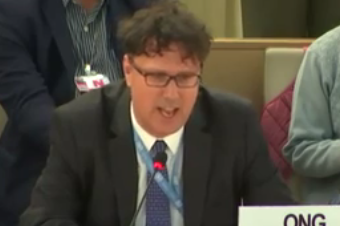
The ICJ today addressed the new UN High Commissioner for Human Rights, Michelle Bachelet, highlighting the role of her office in countering global threats to the rule of law and human rights.
The statement was made at the UN Human Rights Council, during general debate on the High Commissioner’s oral update. It read as follows:
“Madam High Commissioner,
The International Commission of Jurists (ICJ) warmly welcomes you to your new mandate – a mandate that the ICJ has, since 1964, fought to create and support.
A multitude of issues and situations urgently call for your attention. However, a dark cloud looms over them all, and casts its shadow across the globe, including in this chamber. From different directions, various political actors driven by authoritarian ideologies and impulses, thirst for power and fraudulent populisms, grow in strength and are joining forces to mount a concerted attack on the rule of law.
They openly scorn the stated aims of the UN Charter, including “faith in fundamental human rights” and the maintenance of “justice and respect for … international law.” They seek to undermine, defame, and destroy global, regional and national institutions built over decades as bulwarks to protect human rights and human dignity. They thrive on silence or passivity by global leaders and populations, as they assault independent judiciaries, media, and civil society.
Madam High Commissioner, you can make a unique impact by speaking forcefully and publicly in defense of human rights and the rule of law, in defense of victims, and against governments and individuals who demonstrate their hostility or indifference to these aims. The ICJ stands ready to support you and your office in the challenges that lie ahead.
Thank you.”
Sep 5, 2018
The ICJ, together with more than 750 other non-governmental organizations, has written to the new UN High Commissioner for Human Rights highlighting the important role of her office in speaking out for human rights and against governments that violate them.
The joint letter read as follows:
“As local, national, regional, and international civil society organizations from every corner of the world, we offer warm congratulations on your appointment as United Nations (UN) High Commissioner for Human Rights.
We are committed to a world in which every person enjoys human rights and dignity and in which our communities are fair, just and sustainable. We consider that a strong High Commissioner, working in strategic partnership with independent civil society, can contribute significantly to the realization of this vision.
You take up office at a time when human rights are under attack and when we risk the reversal of many of the achievements of the modern human rights movement. We look to you in these troubled times to be an unwavering voice in the defence of human rights, and of victims, rights-holders and human rights defenders around the world.
On every continent, the rights of individuals, communities and peoples are being violated and abused by governments and non-state actors, often with complete impunity. Civil society, peaceful dissidents, and the media are often brutally silenced. The role of your Office in ensuring robust monitoring of, and reporting on, such situations is essential for curbing violations and deterring further abuse, as well as for ensuring justice and accountability. Technical-assistance and capacity building by the OHCHR is also critical and, to be effective, should be approached holistically alongside a rigorous assessment of the rights challenges in the country, including through key indicators to measure progress and assess the degree of engagement and cooperation by the State.
As High Commissioner, you have a unique role to play in bringing country situations of concern to the attention of the UN Human Rights Council and other UN bodies, particularly situations that may not be on their agenda or which receive limited attention, often because of political pressure. This role should extend to providing briefings to the Security Council on situations either on its agenda or that, if left unattended, could represent a threat to international peace and security. Monitoring missions and inter-sessional briefings to the HRC can be initiated at the High Commissioner’s prerogative, on the basis of your Office’s universal mandate, bringing attention to neglected country situations and contributing towards the achievement of the Council’s mandate to prevent human rights violations.
We are aware that the position of High Commissioner comes with its own challenges. Many States will insist you avoid “naming and shaming” and push you to engage in “quiet diplomacy” and to respect national sovereignty. Often, those most intolerant of criticism and most forceful in suppressing dissent will speak the loudest in seeking to mute your voice. Survivors, victims and defenders on the front line in countries where their rights are being violated will rely on you as a human rights champion, to have the courage and conviction to call out violators clearly and publicly, even when it’s challenging or unpopular with governments.
Globally, the rights essential to civic space are being systematically undermined. Civil society and human rights defenders face severe daily risks in their struggle to defend human rights on the ground, including imprisonment, asset-freezes, defamatory campaigns, torture, enforced disappearance, and even death. Risks are also present in the UN context, where individuals frequently face intimidation, harassment or reprisals for their engagement with the UN. We urge you to be a staunch defender of the rights of defenders both on the ground and at the UN, to publicly call out violators, and to undertake or push for investigations into attacks and reprisals. We also encourage you to take full advantage of the distinct, often innovative complementary role of civil society to the work of the OHCHR, and ensure the Office works closely with civil society as a strategic partner at the national, regional, and international levels.
Currently, the human rights framework itself is under unparalleled attack. Authoritarian populists are attacking the universality of human rights, disproportionately and unlawfully restricting rights in the purported interests of “national security,” often tacitly or openly encouraging attacks by their followers or vigilantes on rights defenders as well as the vulnerable and poor, while selectively interpreting human rights and seeking to co-opt or subvert human rights mechanisms to suit their political agendas. Safeguarding and strengthening universal human rights norms and mechanisms should be a core responsibility of the High Commissioner.
The current climate highlights the need for a strong public advocacy role for your mandate in the defence of international human rights law and the international human rights system, as well as a strong role internally within the UN to mainstream respect for human rights throughout the work of UN organs and agencies, and within the Sustainable Development Agenda.
Once again, we congratulate you on your new role, and stand ready to support you and your Office in the fulfilment of your vital mandate.”