Dec 10, 2019 | News
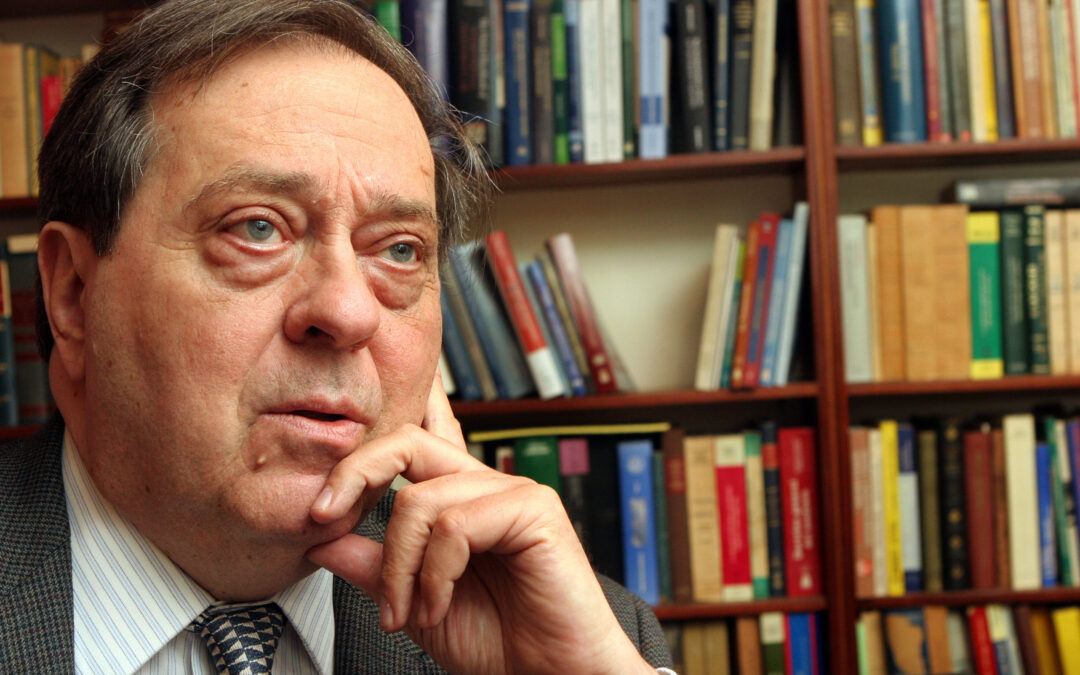
The ICJ mourns the loss of Professor Pedro Nikken, former President and Commissioner of the ICJ. Prof Nikken was elected ICJ President in January 2011, succeeding Mary Robinson (2008-2010) and followed by Nigel Rodley (2012-2017).
“Pedro Nikken left a tremendous legacy of respect for the rule of law and defense of human rights in his homeland of Venezuela, across Latin America and around the world,” said Prof Robert Goldman, the ICJ’s President.
“ Like so many others, I have lost a cherished friend and mentor whose company I will greatly miss,” he added.
Prof Nikken was a former Judge (1979-1989) and President (1983-1985) of the Inter-American Court of Human Rights. He served as UN Independent Expert on El Salvador from 1992 to 1995 and from 1990-1992 he served as Legal Adviser to the UN Secretary-General on El Salvador’s peace process.
In 1995 he served as Special Envoy of the UN Secretary-General to Burundi. He is former Dean and Professor (emeritus) at the Law School of the Universidad Central de Venezuela.
He was also former President and Permanent Counselor of the InterAmerican Institute of Human Rights. He was a Member (Chair N° 9) of the Venezuelan National Academy of Political and Social Sciences.
“Prof Nikken helped drive the ICJ’s work in pursuit of justice and accountability, particularly through regional human rights systems such as the Inter American Court of Human Rights, even as various governments tried to weaken the process and evade responsibility,” said Sam Zarifi, ICJ Secretary General.
“Pedro was indefatigable as a human rights defender and unsurpassed in the quality of his legal analysis, a rare combination of qualities that made him a role model for several generations of human rights lawyers around the world,” he added.
Pedro Nikken was born in Caracas, Venezuela in 1945. He graduated in 1968 from the Andres Bello Catholic University and obtained a diploma of higher studies in law at the Pentheon-Assas University (Paris II) and a doctorate in law from the University of Carabobo.
Dec 10, 2019 | News
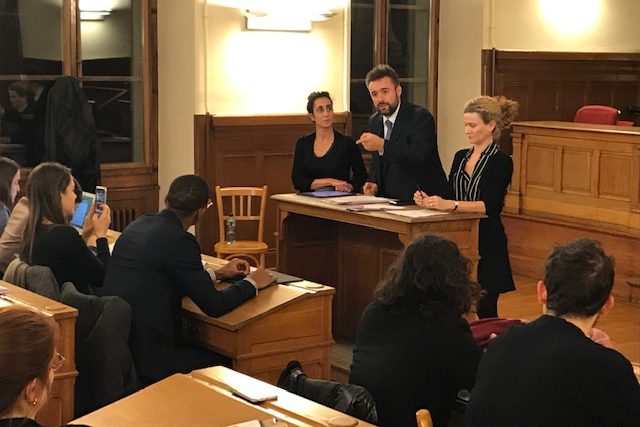
Part of the active ‘International Cooperation Initiative’ between the ICJ and the Geneva Bar Association, a full house conference, attended by Geneva Lawyers, took place tonight at the Palais de Justice of Geneva. The theme was the criminalization of helping migrants for humanitarian motives.
Massimo Frigo, Senior Legal Adviser of the ICJ’s Europe and Central Asia Programme presented this complex issue with regard to the existing protocols of European directives and the reluctance of EU states to respect them.
The conference Le délit de solidarité en droit Suisse, européen et mondial was the first of many collaborations to come on subjects of common interest between the ICJ and the Geneva legal community.
Dec 4, 2019 | News
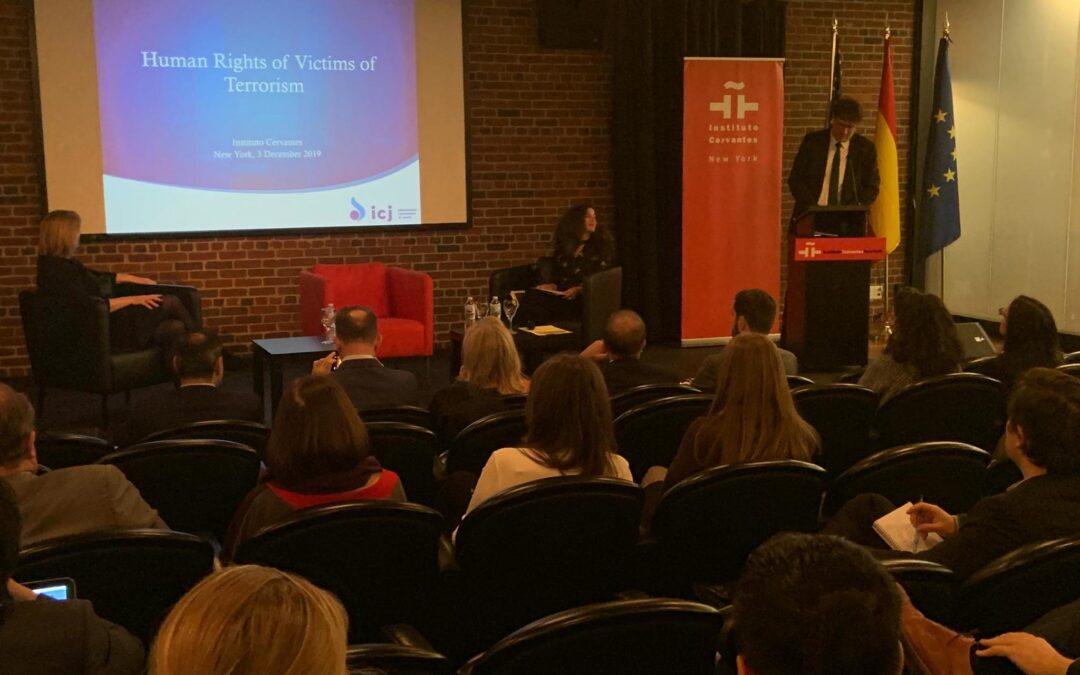
The ICJ has highlighted the human rights of victims of terrorism in a presentation to States’ delegations to the UN in New York.
On 3 December 2019, ICJ Senior Legal Adviser Matt Pollard presented ICJ’s compilation, Human Rights of Victims of Terrorism, at an event organized by the Permanent Missions of Spain and Afghanistan and the UN Office on Counter-Terrorism (UNOCT), with participation by the UN Special Rapporteur on the promotion and protection of human rights and fundamental freedoms while countering terrorism.
In the presentation, the ICJ recognised the achievements of Spain and Afghanistan in establishing a Group of Friends of Victims of Terrorism, and in achieving consensus for a ground-breaking General Assembly resolution in June, and UNOCT’s ongoing work including the UN victims of terrorism support portal.
The ICJ also emphasised key elements such as: the essential role of victims’ associations and other civil society actors; the need to move beyond expressions of solidary to implement concrete measures of assistance; and the need for a human-rights based approach to victims of terrorism.
Among key issues, the ICJ highlighted: effective, rapid and simple access to assistance; access to justice and the truth; recognition and remembrance; avoiding exploitation and re-traumatization; preventing further attacks or violence, while respecting the rule of law and human rights; ensuring involvement of victims’ representatives in designing, implementing and assessing measures for victims; and the importance of international cooperation.
The presentation also looked forward to next steps towards concrete realization of the human rights of victims of terrorism, including through State’s responses to the call in the General Assembly resolution to develop and implement National Action Plans.
For more information contact matt.pollard(a)icj.org
Nov 26, 2019 | News, Publications, Reports, Thematic reports
At the launch of a report on companies’ practices to address complaints relating to their negative impacts on human rights, the ICJ said that many companies have failed to establish and implement effective operational-level grievance mechanisms (OGMs).

Nov 7, 2019 | News
Today, the ICJ published an Arabic translation of Practitioners’ Guide N°12 on Women’s Access to Justice for Gender-based Violence.
The Guide is designed to support legal practitioners and human rights defenders involved or interested in pursuing cases of gender-based violence.
It provides information about regional and international law and standards relevant to gender-based violence, advice on implementing these standards as part of domestic law reform and examples of existing good practice in seeking protection for women.
The Guide (Arabic version here) also addresses the practical issues that are faced by women who have been subject to gender-based violence and the steps that are necessary to secure their access to justice in practice. It considers women’s experiences of the criminal justice system and reflects on how the justice system deals with women’s safety and need for access to services beyond legal assistance.
Download
Universal-Womens accesss to justice-Publications-Practitioners’ Guide Series-2019-ARA (full guide, in PDF)